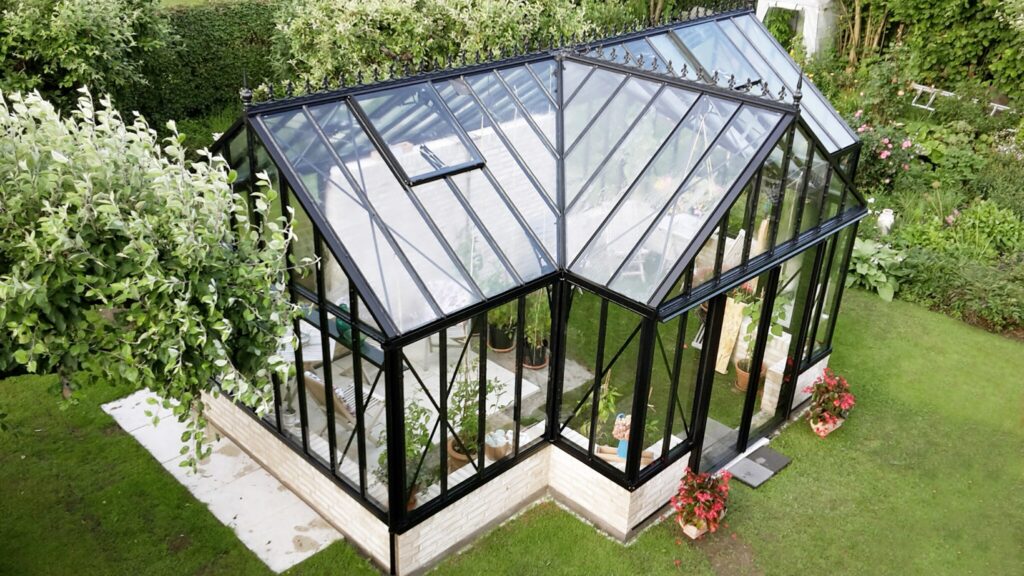
Different types of glazing for a greenhouse
When it comes to the glazing of a typical aluminium garden greenhouse, we generally speak of five different types:
- Traditional horticultural glass
- Toughened safety glass
- Hammered glass
- Polycarbonate
Traditional horticultural glass
This type of flat glass with a thickness between 2 mm and 4 mm is often used for garden greenhouses because of its high light transmission. In addition, the favourable price makes this glass extra attractive.
Horticultural glass is often rolled machine glass or machine-drawn glass in which irregularities and sometimes wavy effects occur. This gives the glass a traditional and natural look.
In addition, there is also float glass, which is of a higher quality. Compared to machine glass, float glass is more expensive but is increasingly becoming the standard in modern greenhouse construction.
With horticultural glass or flat glass, care must be taken in the event of glass breakage: the glass breaks into sharp shards that can cause injury (this can be particularly dangerous with roof glazing).
Toughened safety glass
Toughened safety glass is slightly more expensive than horticultural glass, but much stronger and therefore less fragile. If the glass does break, it disintegrates into small and harmless pieces. It is therefore highly recommended.
Some manufacturers offer safety glass as an option; at Janssens NV, it is the standard. Thanks to the good cooperation with our suppliers, we can offer this glass at a favourable price when you purchase your greenhouse.
Hammered glass
Hammered glass is known for its special surface structure with a pattern. In recent years, this glass has lost some popularity. It used to be used to refract sun rays and create a soft light effect, but it is now hardly used.
The production method of hammered glass is similar to that of rolled glass. The disadvantage of the glass structure is that the thickness is variable throughout the glass (from 2 to 4 mm). This makes the glass less strong and more fragile.
Polycarbonate
Polycarbonate is the solution if you choose a heated greenhouse. This material is lightweight and has excellent insulating properties. Moreover, it will not break easily and is easy to install. A disadvantage of polycarbonate is that it is less durable than glass. In addition, the material is not transparent, giving it a cheaper appearance than glass.
Single or double glazing
In the context of a greenhouse, we generally always speak of single glazing. This type of glazing does not insulate optimally, but there are many insulating means that you can combine with it. Think of: insulation blankets, bubble wrap or other insulating materials.
There are single glazings to which a reflective coating has been applied. This is not insulating glazing, but it can ensure better heat retention and less condensation.
Double glazing also exists, of course, but it is less common and will also cost you a bit more.
Condensation?
Condensation is a natural phenomenon in multiwall sheets due to relative humidity. Water vapour forms droplets when it comes into contact with cool surfaces. These droplets form the liquid in channels or cells of polycarbonate sheets.
To allow these water droplets to disappear, our polycarbonate roof sheets are standardly equipped with AntiDust tape (closed at the top, perforated at the bottom). This allows the condensation moisture/water to drain away and limited air circulation takes place in the roof sheet.
Greenhouse glazing at Janssens
All greenhouses we offer consist of toughened safety glass or a combination of toughened safety glass and polycarbonate. Are you considering buying a greenhouse from us and do you still have questions about glazing?
Then ask our experts for an explanation